Sanctir L1: Design Reference
Version 2.2.1 · October 2026 · Sanctir LLC
This page is the full technical description of the Sanctir L1. For the short, plain-language overview, see Sanctir L1. Everything on this page is free to use, build and change.
Bottom line
The Sanctir L1 is a small drone that flies a route loaded before launch, with no radio link. When its battery runs low it lands, recharges from its own solar panels, takes off again and continues. At the end of the route it flies home, and the operator picks it up and downloads the data.
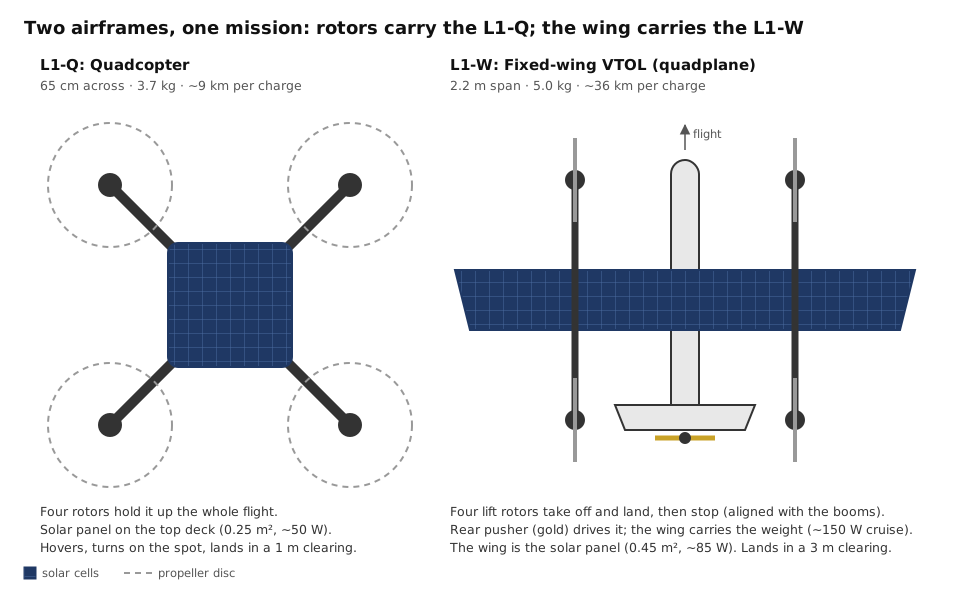
There are two designs. The L1-Q is a quadcopter: compact, precise, short range. The L1-W is a fixed-wing VTOL (a "quadplane"): it takes off and lands like a helicopter but cruises on a wing, and covers about ten times the distance per day. Both use the same flight logic, the same electronics and the same allied-sourced supply chain. A third, heavier hexacopter, the L1-H, is included for utility power-line inspection.
| L1-Q: Quadcopter | L1-W: Fixed-wing VTOL | L1-H: Hexacopter (inspection) | |
|---|---|---|---|
| Best for | Small areas, tight landing spots | Long routes: lines, rivers, borders, ridgelines | Power-line and vegetation surveys |
| All-up weight | 3.7 kg | 5.0 kg | 5.2 kg |
| Size | 65 cm across | 2.2 m wingspan | 90 cm across |
| Cruise speed | 12 m/s (27 mph) | 18 m/s (40 mph) | 12 m/s (27 mph) |
| Cruise power | ~520 W | ~150 W | ~720 W |
| Flight per charge | ~12 min · ~9 km | ~34 min · ~36 km | ~13 min · ~9.5 km |
| Solar | 0.25 m², ~50 W | 0.45 m² on the wing, ~85 W | 0.20 m², ~40 W (optional) |
| Distance per day, real-world sun | ~6.5 km | ~68 km | ~3 km |
| Landing spot needed | ~1 m clear | ~3 m clear | ~1.5 m clear |
| Flight hardware cost (without optional items) | ~$4,700 | ~$6,100 | ~$5,200 |
| Flight software | Ready; passed simulation | Not yet written (port of L1-Q) | Ready (same as L1-Q) |
Figures are engineering estimates from each design's parts list and energy model, at 60% of nameplate solar yield. They will change with weather, terrain, payload and flight testing.
How it works
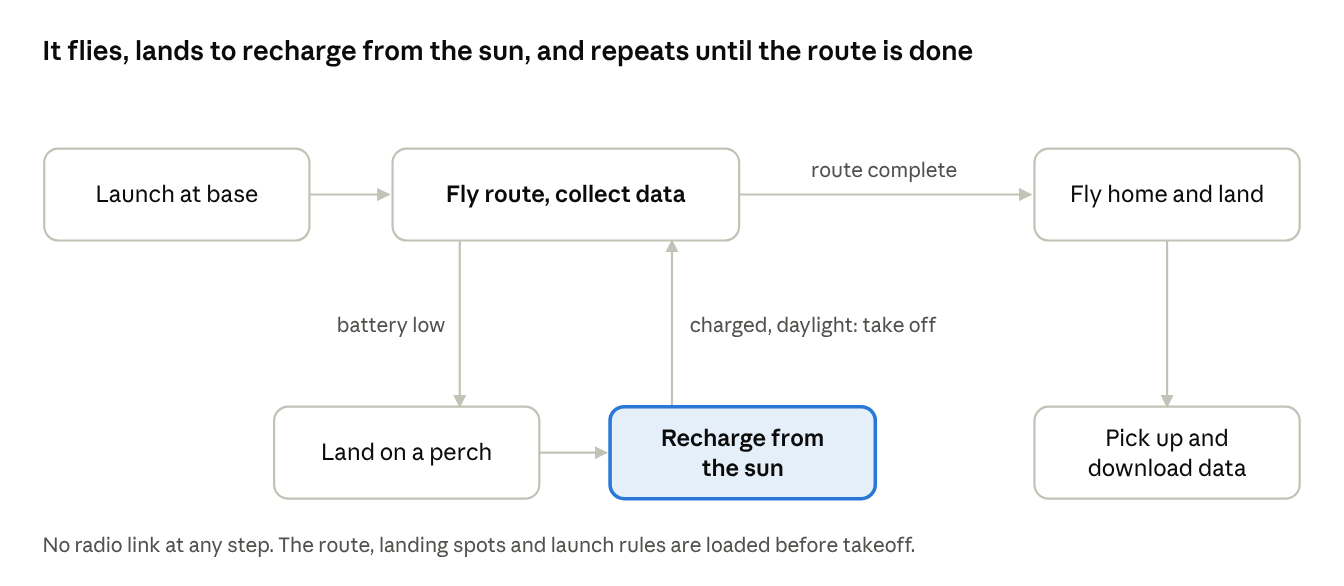
- Plan. The operator loads the route, a list of safe landing spots ("perches") along it, the recovery point, and the launch rules (daylight hours, temperature limits).
- Fly and collect. The drone flies the route and records imagery and sensor data to onboard storage. Nothing is transmitted.
- Decide to land. Every second it compares the energy left in the battery with the energy needed to reach the nearest perch, plus a safety margin. It lands while it can still make it, or at 30% battery regardless.
- Recharge. On the perch it shuts down everything but the flight controller and charges from its panels. Every 45 minutes it disconnects the panels briefly and reads the battery's resting voltage to keep its charge estimate honest. It will not charge below 0 °C or above 45 °C.
- Relaunch. When the battery is at 85% or more, it is daylight, the battery is warm enough, the aircraft is level and GPS is healthy, it takes off and resumes the route at the waypoint where it left off.
- Return. After the last waypoint it lands at the recovery point and stays down. The operator collects it and downloads the encrypted data.
Safety rules built into the software. If a person takes control at any point, it stops acting and waits. If a person lands it by hand, or it fails to make progress past the same waypoint three times, it sets a hold flag and will not fly again until the operator clears it, even after a power cycle. After the mission is complete it will never relaunch on its own.
What's in it
Both designs share the same electronics and systems. Only the airframe and propulsion differ.
| System | What it does | Parts (allied-sourced) |
|---|---|---|
| Flight controller | Flies the aircraft and runs the L1 flight script | ARK Electronics ARKV6X (USA), ArduPilot 4.5 |
| Navigation | Position, heading, altitude | u-blox F9P dual-band GNSS (Ardusimple, Spain); Garmin LIDAR-Lite rangefinder (USA) |
| Collision avoidance | Detects and avoids crewed aircraft | uAvionix pingRX Pro ADS-B receiver (USA) |
| Battery | Stores energy for each leg | 6S Li-ion, Molicel P45B cells (Taiwan), US-assembled pack |
| Battery monitoring | Charge, current, temperature | TI INA228 / INA226 (USA); Microchip MCP9600 thermocouple (USA) |
| Solar charging | Collects and controls solar power | Flexible panels (US or US-laminated); Genasun boost MPPT controller (USA); solid-state relay so the script can stop charging |
| Companion computer | Payload control, data logging, encryption, optional landing-spot selection | Raspberry Pi 5 (UK); optional Hailo-8 AI accelerator (Israel) |
| Payload | What it collects | 12 MP survey camera (Sony sensor); optional 9 Hz thermal camera (Teledyne FLIR, USA) |
| Data security | Protects collected data if the aircraft is lost or found by someone else | Public-key encryption at rest; the private key stays with the operator |
| Identification and lighting | Civil compliance | Broadcast Remote ID (USA); 3-mile anti-collision strobe |
| Weather protection | Survives nights and weather on a perch | Conformal coating, sealed enclosures, drain paths |
Navigation option. Where GPS reception is poor, such as deep canyons or under heavy tree cover, the flight controller and companion computer can be replaced by a ModalAI VOXL 2 (USA, Blue UAS Framework), which adds camera-based navigation. Nothing else changes.
L1-Q: Quadcopter
Four rotors hold the aircraft up for the whole flight. That gives it full control at low speed: it can hover, turn on the spot, hold position in gusts and land on a rooftop, ledge or small clearing. The cost is energy. Lifting the full weight with rotors draws about 520 W, so each charge covers about 9 km, and with a 0.25 m² panel it spends most of its time on the ground recharging. In real-world sun it averages about 6.5 km per day.
Use it when the area is small, landing spots are tight or irregular, or precise hovering over a point matters more than distance.
Energy budget (from the parts list): 194 Wh pack; 107 Wh usable per leg (85% to 30%); 3.7 kg at ~140 W/kg = ~520 W; 12.3 minutes and 8.9 km per leg at 12 m/s; 0.25 m² of panel nets ~78 Wh per day in real-world sun, so one leg's recharge takes ~1.4 days.
Parts list (download spreadsheet · CSV)
| Subsystem | Item | Part | Origin | Qty | Line cost | Line weight |
|---|---|---|---|---|---|---|
| Airframe | Frame | Carbon quad frame, 650 mm class, US-cut tube and CNC plates (e.g. Rock West Composites tube, US plate shop); must carry 15-in props and top-mounted panels | USA | 1 | $350 | 650 g |
| Airframe | Landing gear | Tall wide-stance carbon gear with skid feet, in-house CNC/3D print | USA | 1 | $60 | 150 g |
| Propulsion | Motors | KDE Direct KDE4014XF-380 (6S, 15 in props) | USA (Bend, OR) | 4 | $680 | 660 g |
| Propulsion | Propellers | KDE-CF155-DP 15.5x5.3 carbon (2 CW / 2 CCW) + one spare set | USA | 4 | $88 | 112 g |
| Propulsion | ESCs | KDE-UAS35HVC 35 A+ HV (6S), or one ARK 4IN1 ESC ($218) | USA | 4 | $360 | 144 g |
| Power | Flight battery | 6S2P Li-ion, Molicel P45B 21700 (~194 Wh), US-assembled pack | Taiwan cells / USA pack | 1 | $280 | 900 g |
| Power | Battery monitor | TI INA228 bidirectional, shunt >= 60 A (BATT_MONITOR 21) | USA (TI) | 1 | $30 | 20 g |
| Power | Solar input monitor | TI INA226 on the PV input (BATT2_MONITOR 21) | USA (TI) | 1 | $12 | 5 g |
| Power | Battery temperature | Microchip MCP9600 + K thermocouple on the cells (TEMP1_SRC = battery) | USA | 1 | $25 | 10 g |
| Power | Companion BEC | Mauch Electronics PL 4-14S HYB-BEC 5.3 V / 10 A | Germany | 1 | $45 | 20 g |
| Power | Companion load switch | Pololu MOSFET power switch with logic control (RELAY1) | USA | 1 | $15 | 5 g |
| Power | PV solid-state relay | DC solid-state relay or logic MOSFET switch on the panel + lead, before the MPPT (RELAY2) | USA | 1 | $25 | 20 g |
| Power | Wiring and connectors | XT90/XT60, 12 AWG silicone, JST-GH; Amphenol/TE where practical | Mixed, allied where practical | 1 | $60 | 150 g |
| Solar | Solar panels | Ascent Solar or PowerFilm flexible thin-film modules, ~50 W total, custom laminate | USA | 1 | $300 | 230 g |
| Solar | MPPT charge controller | Genasun GVB-8-Li custom 24.6 V (boost MPPT) | USA | 1 | $230 | 160 g |
| Flight control | Flight controller | ARK Electronics ARKV6X + Pixhawk Autopilot Bus carrier (bundle), ArduPilot 4.5+ | USA | 1 | $750 | 40 g |
| Flight control | GNSS / compass | Ardusimple simpleRTK2B (u-blox ZED-F9P) + ANN-MB multiband antenna | Spain (Swiss chipset) | 1 | $290 | 60 g |
| Flight control | Rangefinder | Garmin LIDAR-Lite v3HP (40 m) or LightWare SF45/B | USA / South Africa | 1 | $150 | 35 g |
| Flight control | Remote ID | uAvionix pingRID or ARK Remote ID (broadcast) | USA | 1 | $100 | 15 g |
| Flight control | ADS-B In | uAvionix pingRX Pro (978/1090 MHz, MAVLink; AVD_ENABLE 1) | USA | 1 | $349 | 8 g |
| Companion | Computer | Raspberry Pi 5, 8 GB | UK (Sony Pencoed) | 1 | $80 | 50 g |
| Companion | AI accelerator | Raspberry Pi AI HAT+ (Hailo-8, 26 TOPS) | Israel / UK | 1 | $110 | 20 g |
| Companion | Cooling | Pi 5 active cooler | UK | 1 | $5 | 20 g |
| Companion | Downward camera | Raspberry Pi Global Shutter Camera (Sony IMX296) + 6 mm lens | UK / Japan | 1 | $75 | 35 g |
| Companion | Storage | High-endurance microSD 64 GB (one for the Pi, one for FC logs) | Japan / Korea / USA | 2 | $30 | 2 g |
| Companion | Mounting | Vibration-damped mounting plate + standoffs | USA | 1 | $20 | 40 g |
| Environmental | Weatherproofing | Conformal coating, sealed electronics enclosures, panel edge seal, drain paths (target IP54 while perched) | USA | 1 | $120 | 120 g |
| Recovery | Locator | Loud buzzer + LED strobe (ArduPilot lost-vehicle alarm) | USA (generic) | 1 | $25 | 20 g |
| Recovery | Anti-collision light | Strobe visible 3 statute miles (proposed Part 108 requirement) | USA | 1 | $40 | 15 g |
| Dev | RC transmitter | RadioMaster ExpressLRS transmitter (safety pilot, testing only) | PRC | 1 | $150 | 0 g |
| Dev | RC receiver | ExpressLRS receiver (safety pilot; flight item during Part 107 testing) | PRC | 1 | $20 | 0 g |
| Dev | Telemetry radio | RFDesign RFD900x pair (ground testing and tuning) | Australia | 1 | $250 | 0 g |
| Dev | Bench charger | Balance charger supporting 6S Li-ion | Varies | 1 | $90 | 0 g |
Flight hardware total: $4,704 and 3,716 g. The L1-Q has no optional items. "Dev" items are test equipment and do not fly on missions.
L1-W: Fixed-wing VTOL (quadplane)
Four small lift rotors on two booms take the aircraft straight up and set it straight down, so it needs no runway and can land on a perch like the quadcopter. Once it is airborne and moving, a rear pusher propeller drives it forward and the wing carries its weight. The lift rotors stop and lock in line with the booms to cut drag.
Why it goes ten times farther per day. Three effects compound:
- The wing holds it up almost for free. A rotor must push the aircraft's full weight downward every second. A wing moving through air makes lift on its own, so the motor only overcomes drag. Cruise power falls from ~520 W to ~150 W.
- It flies faster on that power. At 18 m/s instead of 12, each minute covers 50% more ground. Together with the lower power, each charge goes about four times farther: ~36 km.
- The wing is a bigger solar panel. Solar cells are laminated into the wing's upper skin: 0.45 m² instead of 0.25 m², at no extra drag. It recharges in about half a day instead of about a day and a half.
The trade-offs. It needs a clear spot about 3 m across to land, it spends about 90 seconds per hop on its lift rotors (the most power-hungry part of the flight), and a 2.2 m wing on the ground catches more wind than a compact quadcopter. For routes measured in tens of kilometres, those costs are small next to what the wing returns.
Why four lift rotors and not two. A design with only two vertical lift motors and a rear pusher cannot hold a stable hover: two fixed rotors control roll but not pitch or yaw. The two working versions of that idea are the quadplane used here and the two-motor "tailsitter," which stands on its tail. The quadplane was chosen because ArduPilot supports it well, it lands flat on its belly with the solar wing facing up, and it handles wind better during landing.
Energy budget (from the parts list): 194 Wh pack; 107 Wh usable per leg; 5.0 kg, lift-to-drag ratio 10, 60% propulsive efficiency = ~150 W cruise; ~23 Wh spent on 90 seconds of vertical flight per hop; ~34 minutes and ~36 km of cruise per leg at 18 m/s; 0.45 m² of wing panel nets ~198 Wh per day in real-world sun, so one leg's recharge takes about half a day.
Parts list (download spreadsheet · CSV)
| Subsystem | Item | Part | Origin | Qty | Line cost | Line weight |
|---|---|---|---|---|---|---|
| Airframe | Wing and fuselage | 2.2 m span composite quadplane airframe: fiberglass/carbon skins over foam core, cambered upper surface sized for flush solar laminate; US composite shop or in-house mould | USA | 1 | $900 | 1,300 g |
| Airframe | Lift booms | 2 x carbon tube booms (Rock West Composites) with motor mounts, faired | USA | 1 | $120 | 220 g |
| Airframe | Landing gear | Skids on booms + belly skid; wide stance for perching | USA | 1 | $40 | 80 g |
| Airframe | Control servos | Hitec HS-5087MH digital servos (ailerons x2, elevator, rudder) | Korea / Philippines | 4 | $180 | 88 g |
| Lift propulsion | Lift motors | KDE Direct KDE3510XF-475 (6S) | USA (Bend, OR) | 4 | $540 | 480 g |
| Lift propulsion | Lift propellers | KDE-CF135-DP 13.5 in carbon (2 CW / 2 CCW) + spares | USA | 4 | $88 | 88 g |
| Lift propulsion | Lift ESCs | KDE-UAS35HVC 35 A+ HV, or ARK 4IN1 ESC in the fuselage | USA | 4 | $360 | 144 g |
| Cruise propulsion | Pusher motor | KDE Direct KDE3520XF-400 (6S) | USA (Bend, OR) | 1 | $150 | 180 g |
| Cruise propulsion | Pusher propeller | Folding carbon 14 x 8 (Aeronaut, Germany, or equivalent) | Germany | 1 | $35 | 30 g |
| Cruise propulsion | Pusher ESC | KDE-UAS55HVC 55 A+ HV | USA | 1 | $130 | 60 g |
| Power | Flight battery | 6S2P Li-ion, Molicel P45B 21700 (~194 Wh), US-assembled pack | Taiwan cells / USA pack | 1 | $280 | 900 g |
| Power | Battery monitor | TI INA228 bidirectional, shunt >= 60 A (BATT_MONITOR 21) | USA (TI) | 1 | $30 | 20 g |
| Power | Solar input monitor | TI INA226 on the PV input (BATT2_MONITOR 21) | USA (TI) | 1 | $12 | 5 g |
| Power | Battery temperature | Microchip MCP9600 + K thermocouple on the cells (TEMP1_SRC = battery) | USA | 1 | $25 | 10 g |
| Power | Companion BEC | Mauch Electronics PL 4-14S HYB-BEC 5.3 V / 10 A | Germany | 1 | $45 | 20 g |
| Power | Companion load switch | Pololu MOSFET power switch with logic control (RELAY1) | USA | 1 | $15 | 5 g |
| Power | PV solid-state relay | DC solid-state relay or logic MOSFET switch on the panel + lead, before the MPPT (RELAY2) | USA | 1 | $25 | 20 g |
| Power | Wiring and connectors | XT90/XT60, 12 AWG silicone, JST-GH; Amphenol/TE where practical | Mixed, allied where practical | 1 | $60 | 150 g |
| Solar | Wing solar array | Maxeon monocrystalline cells (Philippines/Malaysia) laminated into the wing upper skin by a US laminator, ~0.45 m2, ~85 W | Philippines / USA | 1 | $600 | 450 g |
| Solar | MPPT charge controller | Genasun GVB-8-Li custom 24.6 V (boost MPPT) | USA | 1 | $230 | 160 g |
| Flight control | Flight controller | ARK Electronics ARKV6X + Pixhawk Autopilot Bus carrier, ArduPilot QuadPlane 4.5+ | USA | 1 | $750 | 40 g |
| Flight control | Airspeed sensor | TE Connectivity MS4525DO digital differential pressure sensor + pitot tube | USA | 1 | $80 | 20 g |
| Flight control | GNSS / compass | Ardusimple simpleRTK2B (u-blox ZED-F9P) + ANN-MB multiband antenna | Spain (Swiss chipset) | 1 | $290 | 60 g |
| Flight control | Rangefinder | Garmin LIDAR-Lite v3HP (40 m), downward | USA | 1 | $150 | 35 g |
| Flight control | Remote ID | uAvionix pingRID or ARK Remote ID (broadcast) | USA | 1 | $100 | 15 g |
| Flight control | ADS-B In | uAvionix pingRX Pro (978/1090 MHz) | USA | 1 | $349 | 8 g |
| Payload | Survey camera | Raspberry Pi HQ Camera (Sony IMX477, 12.3 MP) + 16 mm lens, nadir, belly-mounted | UK / Japan | 1 | $120 | 100 g |
| Payload | Thermal camera (optional) | Teledyne FLIR Boson 320, 9 Hz (ECCN 6A993.a) | USA | 1 | $1,500 | 60 g |
| Companion | Computer | Raspberry Pi 5, 8 GB | UK (Sony Pencoed) | 1 | $80 | 50 g |
| Companion | AI accelerator (optional) | Raspberry Pi AI HAT+ (Hailo-8, 26 TOPS) | Israel / UK | 1 | $110 | 20 g |
| Companion | Cooling | Pi 5 active cooler | UK | 1 | $5 | 20 g |
| Companion | Data storage | NVMe SSD 512 GB + Pi M.2 HAT | Korea / USA | 1 | $80 | 35 g |
| Companion | Log storage | High-endurance microSD 64 GB x2 | Japan / Korea / USA | 2 | $30 | 2 g |
| Environmental | Weatherproofing | Conformal coating, sealed electronics enclosures, panel edge seal, drain paths (target IP54 while perched) | USA | 1 | $120 | 120 g |
| Recovery | Locator | Loud buzzer + LED strobe (ArduPilot lost-vehicle alarm) | USA (generic) | 1 | $25 | 20 g |
| Recovery | Anti-collision light | Strobe visible 3 statute miles (proposed Part 108 requirement) | USA | 1 | $40 | 15 g |
| Dev | RC transmitter | RadioMaster ExpressLRS transmitter (safety pilot, testing only) | PRC | 1 | $150 | 0 g |
| Dev | RC receiver | ExpressLRS receiver (safety pilot; flight item during Part 107 testing) | PRC | 1 | $20 | 0 g |
| Dev | Telemetry radio | RFDesign RFD900x pair (ground testing and tuning) | Australia | 1 | $250 | 0 g |
| Dev | Bench charger | Balance charger supporting 6S Li-ion | Varies | 1 | $90 | 0 g |
Flight hardware total: $7,694 and 5,030 g with the optional thermal camera and AI accelerator; $6,084 and 4,950 g without them. "Dev" items are test equipment and do not fly on missions.
Software status. The L1-W uses the same mission logic as the L1-Q, but ArduPilot's fixed-wing VTOL firmware (QuadPlane) uses different flight modes and takeoff and landing commands, so the script must be adapted and re-tested in simulation before any flight. That version has not been written yet.
L1-H: Hexacopter for power-line inspection
A heavier six-rotor version built for utility corridors. Six motors mean it can lose one and still fly, which matters near energized lines and is expected to be required under the FAA's proposed beyond-visual-line-of-sight rule. It carries a survey camera and optional thermal camera, navigates by dual-antenna GPS heading instead of a magnetic compass (magnetometers are unreliable near high-voltage lines), and logs raw GPS data so images can be precisely located after the flight without a radio link. Solar charging is optional and serves mainly to recover from a long route rather than to extend it.
Parts list (download spreadsheet · CSV)
| Subsystem | Item | Part | Origin | Qty | Line cost | Line weight |
|---|---|---|---|---|---|---|
| Airframe | Frame | Carbon hexacopter frame ~900 mm, US-cut tube and CNC plates | USA | 1 | $450 | 850 g |
| Airframe | Landing gear | Tall wide-stance carbon gear with skid feet, in-house CNC/3D print | USA | 1 | $70 | 200 g |
| Propulsion | Motors | KDE Direct KDE4014XF-380 (6S, 15 in props) | USA (Bend, OR) | 6 | $1,020 | 990 g |
| Propulsion | Propellers | KDE-CF155-DP 15.5x5.3 carbon (3 CW / 3 CCW) + one spare set | USA | 6 | $132 | 168 g |
| Propulsion | ESCs | KDE-UAS35HVC 35 A+ HV (6S), or two ARK 4IN1 ESCs | USA | 6 | $540 | 216 g |
| Power | Flight battery | 6S3P Li-ion, Molicel P45B 21700 (~290 Wh), US-assembled pack (6S4P +450 g for ~22 min legs) | Taiwan cells / USA pack | 1 | $380 | 1,350 g |
| Power | Battery monitor | TI INA228 bidirectional, shunt >= 60 A (BATT_MONITOR 21) | USA (TI) | 1 | $30 | 20 g |
| Power | Solar input monitor | TI INA226 on the PV input (BATT2_MONITOR 21) | USA (TI) | 1 | $12 | 5 g |
| Power | Battery temperature | Microchip MCP9600 + K thermocouple on the cells (TEMP1_SRC = battery) | USA | 1 | $25 | 10 g |
| Power | Companion BEC | Mauch Electronics PL 4-14S HYB-BEC 5.3 V / 10 A | Germany | 1 | $45 | 20 g |
| Power | Companion load switch | Pololu MOSFET power switch with logic control (RELAY1) | USA | 1 | $15 | 5 g |
| Power | PV solid-state relay | DC solid-state relay or logic MOSFET switch on the panel + lead, before the MPPT (RELAY2) | USA | 1 | $25 | 20 g |
| Power | Wiring and connectors | XT90/XT60, 12 AWG silicone, JST-GH; Amphenol/TE where practical | Mixed, allied where practical | 1 | $60 | 150 g |
| Solar | Solar panels (optional) | Ascent Solar or PowerFilm flexible thin-film modules, ~40 W total, custom laminate | USA | 1 | $260 | 200 g |
| Solar | MPPT charge controller (optional) | Genasun GVB-8-Li custom 24.6 V (boost MPPT) | USA | 1 | $230 | 160 g |
| Flight control | Flight controller | ARK Electronics ARKV6X + Pixhawk Autopilot Bus carrier (bundle), ArduPilot 4.5+ | USA | 1 | $750 | 40 g |
| Flight control | GNSS (dual, GPS-for-yaw) | 2 x Ardusimple simpleRTK2B (ZED-F9P) moving-baseline heading kit + 2 multiband antennas | Spain (Swiss chipset) | 1 | $450 | 110 g |
| Flight control | Rangefinder | Garmin LIDAR-Lite v3HP (40 m) or LightWare SF45/B | USA / South Africa | 1 | $150 | 35 g |
| Flight control | Remote ID | uAvionix pingRID or ARK Remote ID (broadcast) | USA | 1 | $100 | 15 g |
| Flight control | ADS-B In | uAvionix pingRX Pro (978/1090 MHz, MAVLink; AVD_ENABLE 1) | USA | 1 | $349 | 8 g |
| Flight control | GNSS mast | Non-conductive fiberglass standoff for the antennas, clear of the carbon frame | USA | 1 | $20 | 30 g |
| Payload | Survey sensor | RGB photogrammetry: Raspberry Pi HQ Camera (Sony IMX477, 12.3 MP) + 16 mm lens, nadir + oblique hard-mount | UK / Japan | 1 | $120 | 100 g |
| Payload | Thermal camera (optional) | Teledyne FLIR Boson 320, 9 Hz (ECCN 6A993.a) ; Lepton 3.5 for coarse hotspot detection at ~$250 | USA | 1 | $1,500 | 60 g |
| Payload | Payload mount | Isolated nadir/oblique hard-mount (photogrammetry needs no gimbal); Gremsy Pixy U (Vietnam, ~$1,000, 300 g) if a stabilised EO/IR turret is required | USA | 1 | $40 | 60 g |
| Companion | Computer | Raspberry Pi 5, 8 GB | UK (Sony Pencoed) | 1 | $80 | 50 g |
| Companion | AI accelerator (optional) | Raspberry Pi AI HAT+ (Hailo-8, 26 TOPS) | Israel / UK | 1 | $110 | 20 g |
| Companion | Cooling | Pi 5 active cooler | UK | 1 | $5 | 20 g |
| Companion | Data storage | NVMe SSD 1 TB (Samsung/Micron) + Pi M.2 HAT | Korea / USA | 1 | $110 | 40 g |
| Companion | Log storage | High-endurance microSD 64 GB x2 | Japan / Korea / USA | 2 | $30 | 2 g |
| Companion | Mounting | Vibration-damped plate + standoffs | USA | 1 | $25 | 50 g |
| Environmental | Weatherproofing | Conformal coating, sealed electronics enclosures, panel edge seal, drain paths (target IP54 while perched) | USA | 1 | $120 | 120 g |
| Recovery | Locator | Loud buzzer + LED strobe (ArduPilot lost-vehicle alarm) | USA (generic) | 1 | $25 | 20 g |
| Recovery | Anti-collision light | Strobe visible 3 statute miles (proposed Part 108 requirement) | USA | 1 | $40 | 15 g |
| Dev | RC transmitter | RadioMaster ExpressLRS transmitter (safety pilot, testing only) | PRC | 1 | $150 | 0 g |
| Dev | RC receiver | ExpressLRS receiver (safety pilot; flight item during Part 107 testing) | PRC | 1 | $20 | 0 g |
| Dev | Telemetry radio | RFDesign RFD900x pair (ground testing and tuning) | Australia | 1 | $250 | 0 g |
| Dev | Bench charger | Balance charger supporting 6S Li-ion | Varies | 1 | $90 | 0 g |
Flight hardware total: $7,318 and 5,159 g with the optional solar charging, thermal camera and AI accelerator; $5,218 and 4,719 g without them. Payload: 220 g against a 454 g budget. "Dev" items are test equipment and do not fly on missions.
Why every part is allied-sourced
Common drone parts (flight controllers, GPS modules, motors, rangefinders, lidar) are overwhelmingly made in China. Federal law bars government agencies and their contractors from buying or operating drones built with those parts, and the FCC now blocks new authorizations for foreign-made drone components. Every part on this page was chosen so that a fire department, a utility on a federal grant, or a federal agency can build and use it.
| Rule | What it requires | This design |
|---|---|---|
| NDAA FY2020 §848; American Security Drone Act (2023); FAR 52.240-1 | No Chinese-made drones or critical components for federal agencies and contractors | Compliant: no Chinese-origin parts in the flight hardware, no DJI or affiliates. The radio-control set used only by the safety pilot during testing is not carried on missions |
| FCC Covered List (Dec 22, 2025) | No new equipment authorizations for foreign-made drone critical components | A home-built prototype needs no authorization; a commercial product would follow the DoD/DHS exemption path |
| Blue UAS (Defense Contract Management Agency) | Vetted platforms and components for Department of Defense purchase | Uses Blue Framework vendors where they exist (ARK, ModalAI, uAvionix) |
| Export controls (EAR 9A012) | Licence for drones flown beyond line of sight with 30–60 min endurance and designed for stable flight in 25-knot gusts, or 1+ hour endurance | The published design is not subject to the EAR (15 CFR 734.7). Built aircraft: the L1-Q and L1-H fly ~12–13 min per charge, well outside 9A012. The L1-W flies ~34 min, so a built L1-W exported from the U.S. needs a 9A012.a.1 classification, which turns on whether it is designed for 25-knot gusts |
| FAA Part 107 / proposed Part 108 | A pilot able to take control today; beyond-line-of-sight rules pending | Test with a safety pilot. Link-free missions now under government (public aircraft) authority, and for others once Part 108 is final. The design already carries ADS-B avoidance, a strobe and Remote ID |
This is a summary of the regulatory position as of October 2026, not legal advice. Operators are responsible for their own approvals.
Building and testing
The software package includes wiring diagrams, every flight-controller setting, the mission-planning rules and a four-step test sequence:
- Simulator. Run the full cycle in ArduPilot SITL. (Done for the L1-Q: the unmodified script diverted on its energy model, reached the landing spot within 3–6 m on every divert, recharged, relaunched, resumed at the saved waypoint, recognised mission completion, and handled reboots on the perch and at the recovery point correctly.)
- Bench. Props off. Check every relay, the charge cut-off when the battery is cold or its sensor unplugged, and the flight log.
- Tether. Props on, safety pilot. One hop. Take control during each phase and confirm the software yields and never relaunches after a manual landing.
- Short mission. Two perches, three legs, in daylight and in sight, with a safety pilot.
No L1 aircraft has flown yet.
Status and limits
- Not flown. The L1-Q's software has passed simulation; the L1-W's software has not been written; no hardware has been built.
- Collection, not surveillance. Data comes back when the aircraft does.
- Weather-bound. No sun, no charge; no charging below freezing; it waits out bad weather.
- Unattended on the ground. A landed aircraft can be picked up by anyone who finds it. Its data is encrypted, so the finder cannot read it, but the aircraft is lost.
- Estimates. Every cost, weight and range figure here is an engineering estimate until measured.
Downloads
| File | What it is |
|---|---|
| Complete package (zip) | Everything below plus the plain-language explainer |
| Flight software (zip) | ArduPilot script, companion-computer program, README with wiring, settings and test plan |
| L1-Q parts list (xlsx) | Quadcopter: parts, origins, costs, weights, energy budget, compliance |
| L1-W parts list (xlsx) | Fixed-wing VTOL: same structure |
| L1-H parts list (xlsx) | Power-line inspection variant |
Licence and contact
Free to use, build, change and include in any program, commercial or government. Text and parts lists: CC BY 4.0. Software: Apache 2.0. Credit Sanctir LLC; nothing else is asked. If you want help adapting it, we will help.
Collin B. George, CISSP · National Security Advisor, Sanctir LLC · cgeorge@sanctir.com
AI assistance was used for source retrieval, verification against primary sources, and editing for tone and clarity. The analysis, judgments and text are the author's, and the author is responsible for the content and any errors.